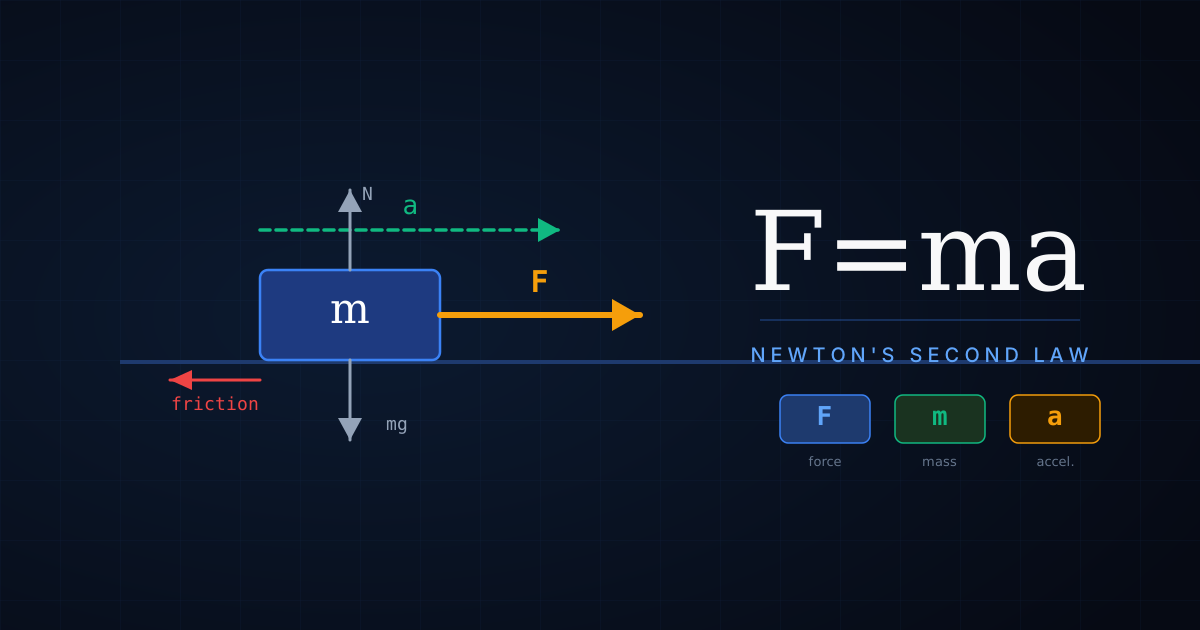
Newton's second law states that F = ma: the net force on an object equals its mass multiplied by its acceleration. F is measured in newtons (N), m in kilograms (kg), and a in metres per second squared (m/s²). One newton is the force required to accelerate a 1 kg mass at 1 m/s².
F = ma looks simple, but the depth is in what each term actually means. Force and acceleration are both vectors — direction matters. Mass resists acceleration. And "F" in the equation is always the net force: the vector sum of every force acting on the object. Get those three things right and you can solve almost any dynamics problem.
- What F, m, and a each mean precisely — and the common mistakes in interpreting each
- How to draw a free-body diagram and resolve forces correctly
- Worked examples with numbers, including inclined planes and connected objects
- How F = ma connects to weight, tension, friction, and normal force
What Is Newton's Second Law?
Newton's Second Law is the relationship between force, mass, and acceleration for any object. In its most direct form: a net force F applied to an object of mass m produces an acceleration a = F/m. The acceleration is in the same direction as the net force. No net force means no acceleration — the object stays at rest or keeps moving at constant velocity (Newton's First Law).
The law is a vector equation: it applies independently in every direction. In two dimensions:
This is why you can analyse the horizontal and vertical components of motion separately — they're linked only through the shared time t, not through the forces (unless a force has components in both directions).
Which Law Is F = ma?
F = ma is Newton's Second Law of Motion, the second of the three laws published by Isaac Newton in his 1687 work Philosophiæ Naturalis Principia Mathematica. For reference, the three laws are:
| Law | Statement | Equation |
|---|---|---|
| First Law (Inertia) | An object remains at rest or in uniform motion unless acted on by a net force | F_net = 0 → a = 0 |
| Second Law (F = ma) | Net force equals mass times acceleration | F = ma |
| Third Law (Action-Reaction) | Every action has an equal and opposite reaction | F₁₂ = −F₂₁ |
Who Discovered F = ma?
Sir Isaac Newton (1643–1727) formulated the principle behind F = ma, published in Principia Mathematica in 1687. Newton originally expressed the second law in terms of momentum: the rate of change of momentum of an object is proportional to the net force acting on it. Written mathematically:
For constant mass m, d(mv)/dt = m·(dv/dt) = m·a, which gives the familiar F = ma. The modern algebraic form we use today was formalised by Leonhard Euler in the mid-18th century, but the physical discovery is Newton's. Newton built on Galileo's observation that falling objects accelerate uniformly regardless of mass, extending it to a universal law applicable to all forces.
Breaking Down F = ma
F is net force — the vector sum of all forces acting on the object. If gravity pulls down with 50 N and the normal force pushes up with 50 N on a stationary object, the net force is 0 N, so acceleration is 0. F = ma never uses a single force in isolation — it uses the resultant of every force acting.
m is inertial mass — the object's resistance to acceleration, measured in kilograms. A more massive object accelerates less for the same applied force. Mass is not the same as weight: mass is a fixed property of the object; weight is the gravitational force on it (W = mg).
a is the acceleration produced — always in the same direction as the net force, measured in m/s². If F_net points north, a points north. If F_net = 0, a = 0.
The F = ma Formula — Three Ways to Use It
Use F = ma when you know mass and acceleration and need the force. Use a = F/m when you know force and mass and need the acceleration (most common in kinematics problems). Use m = F/a when you're given force and acceleration and need to find mass (less common but appears in problems involving rockets and unknown loads).
Worked Example 1: Finding Acceleration
A net force of 40 N acts on a 5.0 kg trolley. Find its acceleration.
Direction: same as the 40 N force. If the force is horizontal, the trolley accelerates horizontally at 8 m/s².
Worked Example 2: Multiple Forces
A 2.0 kg box on a frictionless surface has two forces acting on it: 12 N to the right and 4 N to the left. Find the acceleration.
Net force = 12 − 4 = 8 N to the right.
Worked Example 3: Including Friction
A 10 kg block is pushed along a horizontal surface with a 60 N force. The frictional force opposing motion is 20 N. Find the acceleration.
Net force = 60 − 20 = 40 N (in the direction of motion).
Note: if the question didn't specify "frictionless", always check whether friction or air resistance is given and subtract it from the driving force before applying F = ma.
Worked Example 4: Two-Dimensional Problem
A 3.0 kg object has a 15 N force acting at 53° above the horizontal. Find the horizontal and vertical accelerations (ignore gravity for this example).
Resolve the force into components:
Apply F = ma to each axis:
Worked Example 5: Finding Force Needed to Stop
A 1,200 kg car travelling at 25 m/s brakes to a stop in 50 m. Find the braking force.
First find acceleration using v² = u² + 2as (SUVAT):
Then apply F = ma:
This shows how F = ma and SUVAT equations work together — SUVAT gives you acceleration from kinematics, then F = ma converts it to force. Use the Newton's second law calculator to verify your answers.
F = ma and Momentum
Newton originally stated the second law using momentum p = mv. The more general form is:
For constant mass: F = m(dv/dt) = ma. But the momentum form is essential when mass changes — like a rocket expelling propellant, or a raindrop collecting mass as it falls. In those cases, F ≠ ma; you must use F = dp/dt. The conservation of momentum article covers these variable-mass situations in detail.
The Connection to Weight
Weight is just F = ma applied to gravity. The gravitational force on a mass m near Earth's surface is:
where g = 9.8 m/s² is the gravitational field strength (acceleration due to gravity). This is F = ma with F = W (weight) and a = g. On the Moon, g = 1.62 m/s², so a 70 kg person weighs 70 × 1.62 = 113 N — about one-sixth of their Earth weight of 686 N. Their mass is the same on both; only their weight changes.
F = ma Across Physics — Where It Shows Up
Rocket propulsion: F = dp/dt governs thrust. A rocket engine expelling propellant at mass flow rate ṁ and exhaust velocity v_e produces thrust F = ṁv_e. The Tsiolkovsky rocket equation — governing the relationship between propellant mass, final velocity, and exhaust speed — is derived directly from Newton's second law in its momentum form.
Structural engineering: every load calculation in a building uses F = ma. Static loads have a = 0, giving ΣF = 0 (equilibrium). Dynamic loads — earthquakes, wind gusts, impact — require the full F = ma with realistic accelerations. Earthquake-resistant buildings are designed to survive lateral accelerations of 0.2–0.5g without collapse.
Fluid mechanics: the Navier-Stokes equations, which govern the flow of all fluids, are Newton's second law applied to a fluid element. F = ma for a small volume of fluid, accounting for pressure, viscosity, and body forces, gives the equations that govern everything from blood flow to weather systems to aircraft aerodynamics.
Electromagnetism: the Lorentz force law F = q(E + v × B) gives the force on a charged particle in electromagnetic fields. Combined with F = ma, it describes the motion of electrons in circuits, protons in particle accelerators, and ions in mass spectrometers.
Where F = ma Breaks Down
Newton's second law in the form F = ma works with extraordinary precision for everyday speeds and scales. It breaks down in two regimes:
Very high speeds (approaching c): Special relativity replaces ma with d(γmv)/dt, where γ = 1/√(1 − v²/c²). For v ≪ c, γ ≈ 1 and we recover F = ma. The LHC protons are travelling at 0.9999997c — for those, relativistic corrections are enormous and F = ma would give completely wrong predictions.
Atomic and subatomic scales: quantum mechanics governs the behaviour of particles at the scale of atoms. Position and momentum can't both be known precisely (Heisenberg uncertainty principle). The classical trajectory described by F = ma simply doesn't exist at quantum scales — you have probability amplitudes and wavefunctions instead.
For everything in between — from dust particles to spacecraft, from milliseconds to geological timescales, from micronewtons to meganewtons — F = ma works. The range of its validity is extraordinary.
Common Mistakes
Using a single force instead of net force. F in F = ma is always the vector sum of all forces. If a 100 N push is opposed by 30 N of friction, F_net = 70 N — not 100 N. Using 100 N gives the wrong acceleration.
Confusing mass and weight. Mass (kg) is resistance to acceleration; weight (N) is the gravitational force. Weight = mg. You feel heavier in a lift accelerating upward not because your mass increased but because the normal force from the floor exceeds your weight (N − mg = ma → N = m(g+a)).
Forgetting that acceleration can oppose velocity. A decelerating object has acceleration opposing its direction of motion — the net force is backward. Deceleration is not a separate concept; it's just acceleration with a sign opposite to velocity.
Applying F = ma to systems instead of individual objects. In multi-body problems (e.g. connected masses), write separate F = ma equations for each body. The internal forces (tension, contact forces) cancel in the system equation but appear individually in each body's equation — that's how you find them.
Frequently Asked Questions
What is Newton's Second Law F = ma?
Which law is F = ma — Newton's first, second, or third?
What does each symbol in F = ma stand for?
Why does F = ma use net force and not just force?
What is 1 newton in terms of F = ma?
When does F = ma not apply?
Share this article
Written by
Physics Fundamentals Editorial Team
Written and reviewed by our team of physics educators. Content is aligned with A-Level, GCSE, AP Physics, and undergraduate curricula.
About Physics Fundamentals →