Every engine ever built obeys it. Every diet plan is secretly about it. Every star in the sky is constrained by it. The first law of thermodynamics — that energy cannot be created or destroyed, only moved or transformed — is one of those rare principles that genuinely has no exceptions.
The equation ΔU = Q − W looks simple, but the signs trip students up constantly, and the physical meaning of each term is subtler than it first appears. Get comfortable with this equation and you have the foundation for all of thermodynamics: heat engines, refrigerators, adiabatic processes, and the connection between heat and work.
- What ΔU, Q, and W each mean — and how to get the signs right every time
- How the first law applies to different thermodynamic processes (isothermal, adiabatic, isochoric)
- Why you can't build a perpetual motion machine of the first kind
- Worked examples including engines, gas compression, and heat exchange
The Statement of the First Law
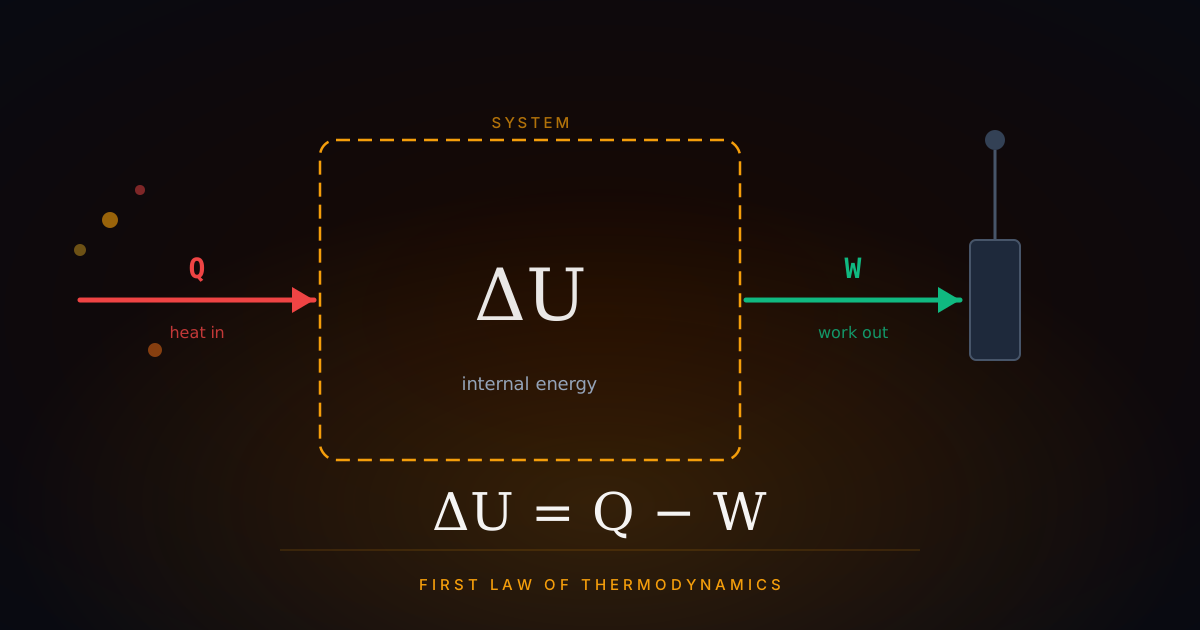
The first law of thermodynamics (also written as the "1st law of thermodynamics") states: The change in internal energy of a system equals the heat added to the system minus the work done by the system.
Here, ΔU is the change in internal energy (the total kinetic and potential energy of all the molecules inside the system), Q is the heat transferred into the system (positive when heat flows in, negative when it flows out), and W is the work done by the system on its surroundings (positive when the system expands, negative when it's compressed).
This equation is a bookkeeping law. Energy cannot appear from nothing and cannot disappear — every joule of energy is accounted for. If you add heat to a gas and the gas doesn't do any work (constant volume), all the heat goes into increasing the internal energy — the gas gets hotter. If the gas expands and does work but no heat flows in, the internal energy decreases — the gas cools down. The first law tells you exactly how these quantities balance.
Internal Energy
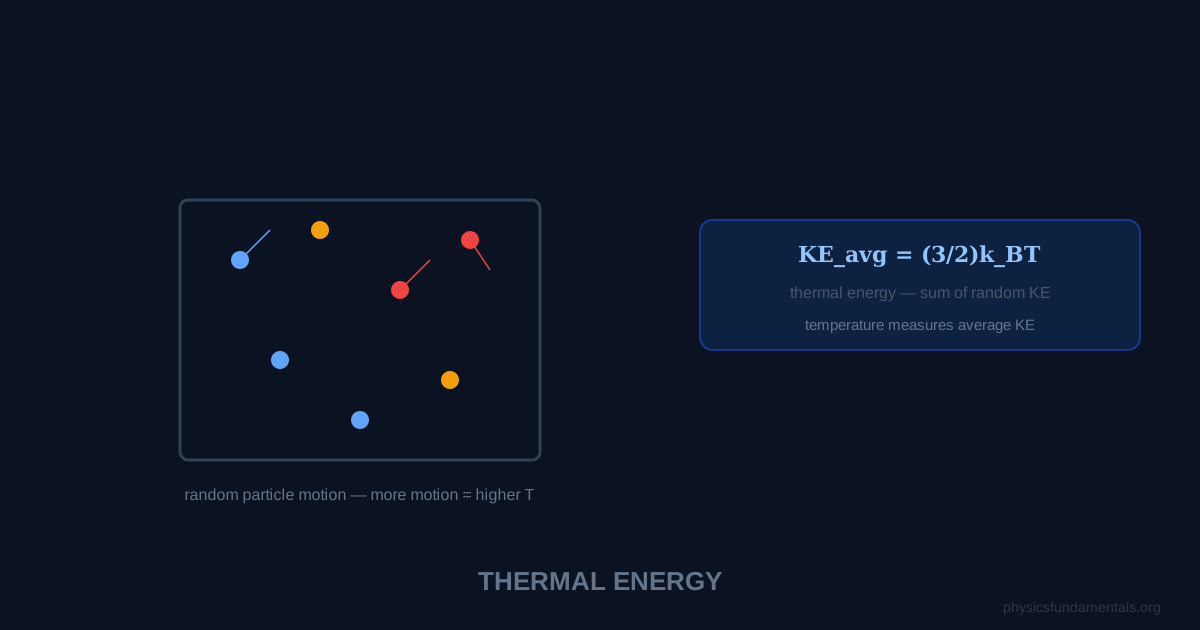
Internal energy (U) is the sum of all microscopic energies in a system — the translational kinetic energy of molecules zooming around, rotational kinetic energy of molecules tumbling, vibrational energy of atoms within molecules, and the potential energy of intermolecular forces. For an ideal gas (a useful simplification), internal energy depends only on temperature:
where n is the number of moles, Cv is the molar heat capacity at constant volume, and T is absolute temperature in kelvin. This is why temperature is so fundamental in thermodynamics — it directly measures the internal energy of an ideal gas. Raising the temperature always means increasing internal energy.
Heat and Work: Two Ways to Change Internal Energy
There are exactly two ways to change the internal energy of a system: transfer heat across its boundary, or let it do (or have done on it) mechanical work. Heat is energy transfer driven by a temperature difference — it flows spontaneously from hotter to colder. Work is energy transfer through macroscopic mechanical means — a piston compressing a gas, for example.
Crucially, heat and work are not properties of a system — they are processes of energy transfer. You can't say a gas "contains" a certain amount of heat; you can only say heat was transferred to or from it. Internal energy, by contrast, is a property of the system's state. This distinction is one of the conceptual pillars of thermodynamics.
Thermodynamic Processes
The first law takes different simplified forms in special processes:
Isothermal process (constant temperature): For an ideal gas, ΔU = 0 (since U depends only on T). Therefore Q = W — all heat input goes directly into work output. This is why isothermal processes appear in ideal engine cycles.
Adiabatic process (no heat transfer, Q = 0): ΔU = −W. The system's internal energy changes only through work. When a gas expands adiabatically, it does positive work and its internal energy (and temperature) decreases — this is why air cools as it rapidly expands, and why diesel engines ignite fuel without spark plugs.
Isochoric process (constant volume, W = 0): ΔU = Q. All heat goes into changing internal energy. No work is done because there's no volume change. This is the scenario in a rigid sealed container.
Isobaric process (constant pressure): Both Q and W are non-zero, and the general first-law equation applies. Cooking at atmospheric pressure approximates this condition.
Connection to the Physics of Engines
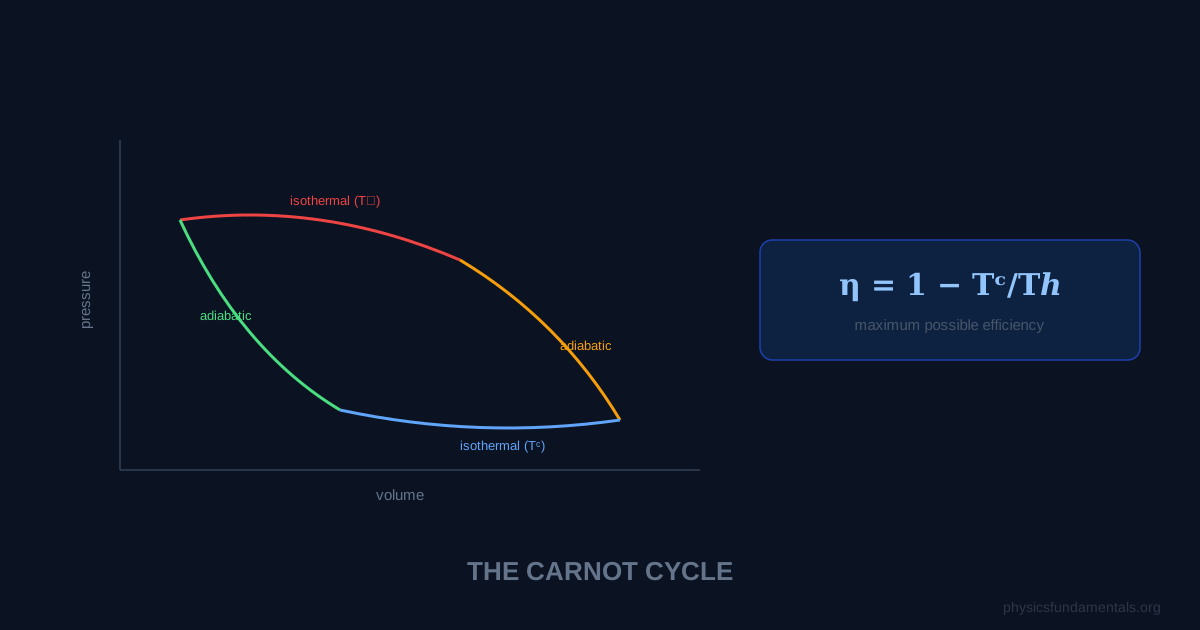
The first law explains why a perfect heat engine — one that converts 100% of heat into work — is impossible. To run a cycle (return to the same state), the change in internal energy over a complete cycle is zero (ΔU = 0). Therefore Q = W for the cycle as a whole: you can only get out as much work as net heat flows in. The second law of thermodynamics then adds a further constraint — some heat must always be exhausted to the environment. The interplay of these two laws defines the maximum possible efficiency of any heat engine.
Everyday Applications
The first law is everywhere. Your body is a thermodynamic system: you consume food (chemical energy), your metabolism converts it to internal energy and heat, you do work (exercise), and you radiate heat to stay at constant temperature. Every calorie you count is a measure of the internal energy stored in food, governed by the same equation that governs steam engines and stars. The first law of thermodynamics connects the physics of energy to every process in the physical and biological world.
Worked Example 1: Gas in a Cylinder
A gas absorbs 500 J of heat and expands, doing 200 J of work against a piston. Find the change in internal energy.
The internal energy increases by 300 J — the gas absorbed more heat than it used doing work.
Worked Example 2: Adiabatic Compression
An adiabatic process has no heat exchange (Q = 0). A gas is compressed, with 400 J of work done on it. Find ΔU.
Work done on the gas = −(−400) = W is done by gas = −400 J (compression means the gas has work done on it, not by it)
The internal energy increases by 400 J — all the work of compression goes into increasing the gas temperature (why diesel engines ignite fuel by compression alone).
Worked Example 3: Heat Engine Efficiency
A heat engine absorbs 800 J of heat from a hot reservoir each cycle and rejects 500 J to a cold sink. Find the work done per cycle and the engine's efficiency.
Now suppose the hot reservoir is at T_h = 500 K and the cold sink is at T_c = 300 K. The theoretical maximum (Carnot) efficiency for any engine operating between these two temperatures is:
The engine's actual efficiency (37.5%) is below the Carnot maximum (40%), exactly as the second law requires — no real engine can reach or exceed the Carnot limit, only approach it. The gap between an engine's actual efficiency and its Carnot limit is a measure of how much room remains for engineering improvement.
Worked Example 4: Refrigerator Coefficient of Performance
A refrigerator's compressor does 150 J of work per cycle, extracting 450 J of heat from the cold interior. Find the heat rejected to the room and the coefficient of performance (COP).
A COP of 3.0 means the refrigerator moves 3 J of heat out of the cold interior for every 1 J of electrical work it consumes — this is why refrigerators and heat pumps can seem to "beat" 100% efficiency: they're not creating energy, they're moving existing heat, and moving heat costs far less energy than generating an equivalent amount from scratch. Typical household refrigerators have a COP between 2 and 4; the value falls as the temperature difference between the cold interior and the room increases, since more work is needed to pump heat across a larger gap.
Thermodynamic Processes at a Glance
| Process | Constraint | First law simplification |
|---|---|---|
| Isothermal | T = constant | ΔU = 0 → Q = W |
| Adiabatic | Q = 0 | ΔU = −W |
| Isochoric (const V) | V = constant, W = 0 | ΔU = Q |
| Isobaric (const P) | P = constant | ΔU = Q − PΔV |
Applications
Heat engines (petrol, diesel, steam): a working fluid absorbs heat Q_h from a hot source, does work W, and rejects heat Q_c to a cold sink. By the first law: W = Q_h − Q_c. Efficiency η = W/Q_h = 1 − Q_c/Q_h. The second law limits efficiency further: no engine can exceed Carnot efficiency η_max = 1 − T_c/T_h. Refrigerators: work W is done on the refrigerant, which absorbs Q_c from the cold interior and rejects Q_h = Q_c + W to the room. Human metabolism: you absorb chemical energy Q from food, do mechanical work W (moving, lifting), and reject the rest as body heat. At rest, a human dissipates ~80 W as heat.
First Law and Specific Heat Capacity
For a solid or liquid at constant volume (negligible expansion), W ≈ 0, so ΔU = Q = mcΔT. This links the first law to specific heat capacity c. For gases at constant pressure, work is done during expansion: W = PΔV = nRΔT (from ideal gas law), so Q = ΔU + nRΔT. This gives rise to two heat capacities for gases: C_V (constant volume, all energy goes to ΔU) and C_P = C_V + R (constant pressure, energy split between ΔU and work). For ideal monatomic gas: C_V = (3/2)R = 12.5 J mol⁻¹ K⁻¹; C_P = (5/2)R = 20.8 J mol⁻¹ K⁻¹. The ratio γ = C_P/C_V = 5/3 ≈ 1.67 appears in adiabatic processes and the speed of sound in ideal gases.
Historical Context
The first law emerged from the work of three scientists in the 1840s: James Prescott Joule demonstrated that mechanical work and heat are equivalent (Joule's paddle wheel experiment, 1843 — mechanical stirring of water raised its temperature precisely as predicted by ΔU = W). Julius Robert von Mayer independently formulated energy conservation for thermal and mechanical processes in 1842. Hermann von Helmholtz gave the first comprehensive mathematical statement in 1847. Before this work, heat was believed to be a substance ("caloric") — the first law established it as a form of energy transfer. The unit joule is named after Joule in recognition of this work.
Common Mistakes
Sign convention confusion. ΔU = Q − W (standard physics convention: W is work done by the system) vs ΔU = Q + W (engineering convention: W is work done on the system). Always identify which sign convention a textbook uses before solving problems. Conflating heat and temperature. Heat Q is energy transferred; temperature T is a measure of average molecular kinetic energy. Adding the same heat Q to different masses of the same material produces different temperature changes (ΔT = Q/mc). Forgetting work is PΔV for gases. For gas expansion at constant pressure: W = PΔV. At constant volume (isochoric), ΔV = 0, so W = 0 and ΔU = Q.
Frequently Asked Questions
What is the first law of thermodynamics?
What is internal energy in thermodynamics?
What is the difference between heat and work in the first law?
What is an adiabatic process?
Why is a perpetual motion machine impossible?
Share this article
Written by
Physics Fundamentals Editorial Team
Written and reviewed by our team of physics educators. Content is aligned with A-Level, GCSE, AP Physics, and undergraduate curricula.
About Physics Fundamentals →